

You’re a point.
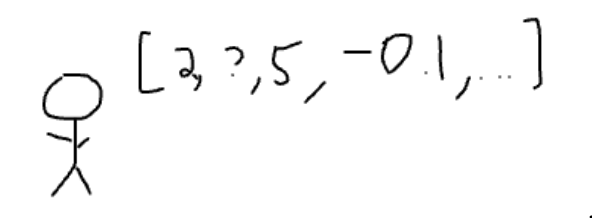
A point that has a countably infinite number of elements. These elements, under some very abstract and philosophical field (a typical field would be the reals, for instance, but this is very abstract), uniquely define who you are. Two people with the same point data are alike in every way and can be interchanged without anyone noticing. Each element in this infinitely long point corresponds to some property that defines who you are: Age, mental state, quantitative skills, knowledge of NY history, ability to solve a specific math problem, involvement in WWIII, geographic location, contribution to climate change, net worth. etc. These properties could be fundamental, acquired through genetics, or forged through years of struggle or deprivation. For the sake of reasonable discussion, these are objective fields that others may choose to look at under different lenses. You may notice that some of the fields are dependent, but that’s fine as long as every field contributes to some amount of new information about the person - we don’t have any redundant information in a human point.
Like all points in Euclidean geometry, this point can be thought of as a vector from the origin to the point. Note that the origin isn’t your starting point - it’s just some arbitrary point of reference that will become useful later on. To keep things clean, all single attribute vectors are orthogonal to each other - much like the standard x, y, and z axis. Let’s call this vector a human vector. Any action that you take will prompt a change in value. Any choice (conscious or not) will change some fields. Through every moment of the day, your vector changes in subtle but important ways. You have displacement - you’re growing (or regressing) as a person whether you like it or not.
What fields matter?
We cannot keep track of an infinite number of fields. You usually care about a finite subset of these at any given moment with different priorities for each one. This naturally motivates the priority vector, the aggregate vector formed by the sum of all your attribute weights times the standard basis vector for those corresponding attributes. (in the positive direction, I suppose). For undesirable things, like being an alcoholic, you can have negative weight as well. This will serve as your (often implicit) measuring stick as you view yourself and others in this world. We will now introduce the self-worth vector - the projection of your human vector onto your priority vector. The magnitude of this examines how in line you are with your priorities. However, the magnitude on its own doesn’t mean much. So let’s throw other people into the picture.
Other people have human vectors too
Everyone else can also be defined as a set of infinitely many attributes, the aggregate of which forms the unique existence state of that person. If you’re alive, you have a vector. (Someone who’s not conscious or rational will still have a human vector, but perhaps not a very interesting one…) To facilitate comparison, we imagine that every person’s ith field corresponds to the same property globally. (We are also assuming that as a collective whole, humanity only has a countably infinite number of possible attributes. If that’s not the case, this human vector analogy falls flat on its face since we cannot index every single property in a single human vector.)
How we compare to others
Comparing to others is also a natural part of being human. For our vector analogy, this is usually done by taking someone’s human vector and projecting it onto our priority vector. We can’t exactly find someone else’s vector, but we can get a rough estimate by examining awards/daily behavior/external pieces of work produced by that person (like a blog post), which are (lossy) projections of that person’s human vector onto the external world. (Where one lives or what kind of accolades one had achieved growing up could tell us a lot about that person, or maybe give a distorted view of them.) Once projected onto our priority vector, if we find that the resulting vector has a significantly higher magnitude than our self-worth vector, we may end up feeling inferior. We can a) feel depressed about such a fact and give up trying or b) Shift our priorities so that the projection of their human vector onto our updated priority vector is a bit more manageable (oh look, this math nerd doesn’t touch grass and I do, etc..) or c) examine the difference vector and set it as a personal goal to reduce its magnitude as much as possible. Unfortunately, it’s very easy to fall into the first two cases and take no action on our part.
How we should instead compare to others
We should instead compare daily/weekly displacement vectors projected onto our self-worth vectors. It’s a forward-looking, inspiring approach. - Unfortunately, thinking about the fundamental nature of humanity is time-consuming and this will have to wait until next week. Anyways, here’s something to look at in a new light: